

Housing societies
Solar for housing societies, one application for the whole roof.
Sized to the common-services bill, the lifts, pumps, corridor lights and the clubhouse, with the society's assistance applied for by us.
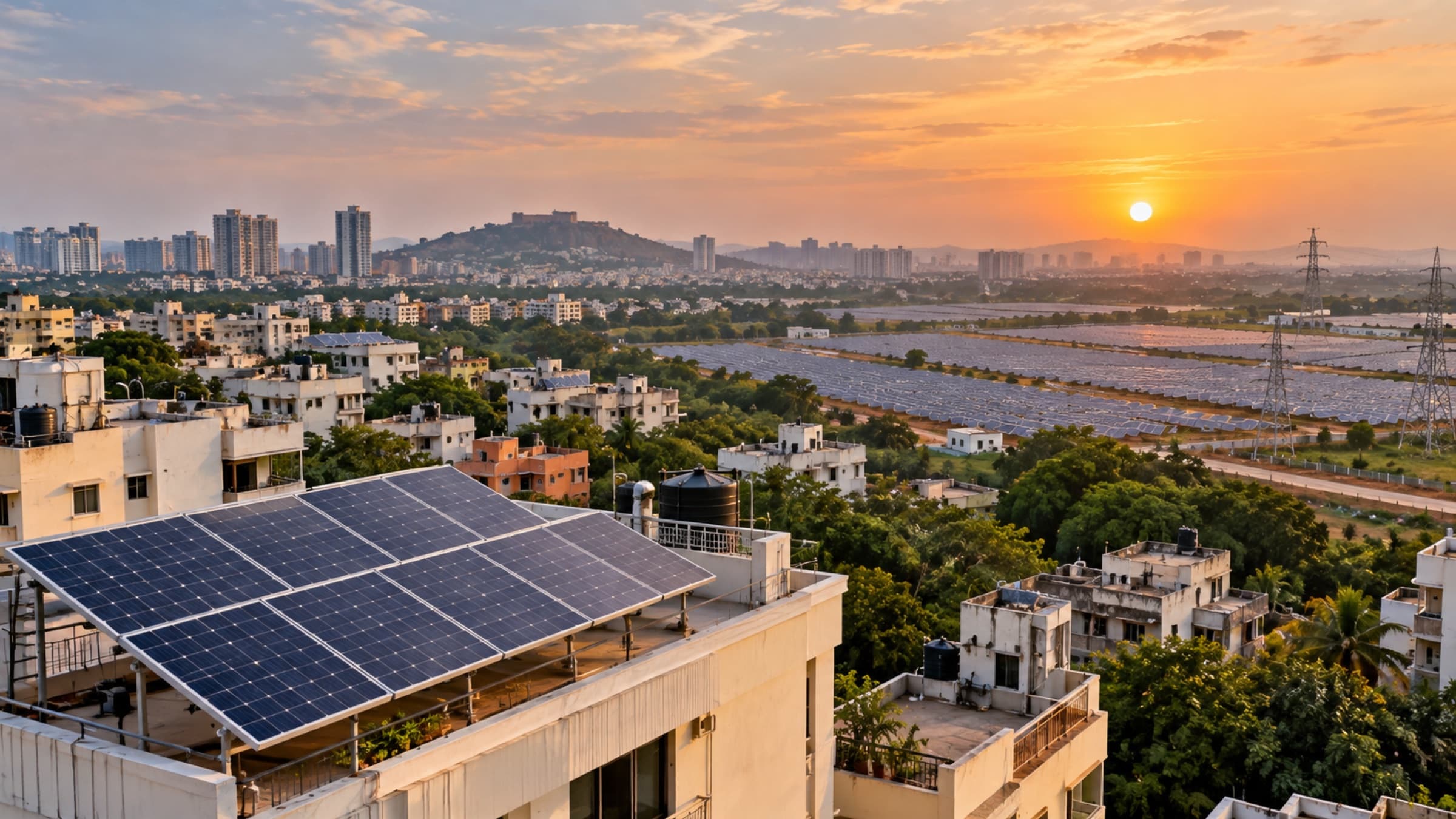
Illustrative image, not a Leo installation.
Your number, society.
Society
Your estimate
Kept over 25 years, about Rs 67.5 lakh, before tariff rises.
Replies during office hours. Estimates only, not a quotation.
Your estimate, as text
Solar estimate: Society, bill Rs 25,000 a month

System size: 21 kWp. Assumes 2,500 kWh a month at Rs 10.00 per unit, 4 sun hours a day (1,460 kWh per kWp a year) and 85 sq ft of roof per kWp.
Monthly saving: about Rs 22,500. Assumes 90% of the generation offsets the bill through daytime use and net metering.
System cost: Rs 8.6 to 11 lakh. From the MNRE benchmark cost for rooftop solar, general category states: Rs 50,000 per kW for the first 2 kW and Rs 45,000 per kW after, in force from 13 Feb 2024, with a band of 0.9x to 1.15x. Checked 5 Sep 2026.
PM Surya Ghar assistance: Rs 3.8 lakh. Society rule: Rs 18,000 per kW for common facilities, up to 500 kW. Source: MNRE operational guideline for PM Surya Ghar, OM 318/17/2024-GCRT of 7 Jun 2024, checked 5 Sep 2026.
Cost after assistance: Rs 4.8 to 7.2 lakh.
Payback: 2 to 3 years. The cost after assistance divided by a year of the saving.
Kept over 25 years: Rs 67.5 lakh. The monthly saving over 300 months, before tariff rises and without panel degradation.

Tariff as of 5 Sep 2026: TGERC retail supply tariff order FY 2025-26, LT-I(B)(ii) domestic, above 800 units a month, the slab a residential building's common services are billed at.
This is an estimate from the assumptions above. A roof survey and a written proposal replace it.

https://leo-solar.in
How we got this, and your own tariff
How we got this. Tariff Rs 10.00 per unit (LT-I(B)(ii) domestic, above 800 units a month, the slab a residential building's common services are billed at, Telangana), 4 units per kWp per day (1,460 a year, a normal south Indian rooftop yield), 85 sq ft of roof per kWp. Benchmark cost Rs 50,000 per kW for the first 2 kW and Rs 45,000 after (MNRE, 13 Feb 2024), with a band of 0.9x to 1.15x. Housing society assistance Rs 18,000 per kW up to 500 kW (MNRE guideline, 7 Jun 2024). Tariff from the TGERC retail supply tariff order FY 2025-26, checked 5 Sep 2026. Daytime use assumed at 90%. This is an estimate; the number that matters comes from a roof survey, in writing.
PM Surya Ghar
The society rule
What PM Surya Ghar pays a housing society or resident welfare association for a system on its common facilities, as the ministry publishes it.
PM Surya Ghar, housing societies and RWAs
Rs 18,000 per kW
- Applies to
- The common facilities of a housing society or resident welfare association: lifts, pumps, corridor lighting and the clubhouse.
- Up to
- 500 kW for the whole society.
- Counted at
- 3 kW per house. The residents' own rooftop systems count inside the same limit.
- Source
- MNRE operational guideline for PM Surya Ghar, OM 318/17/2024-GCRT, 7 Jun 2024. Checked 5 Sep 2026.
The assistance is paid against the size the DISCOM approves, into the society's account, after the net meter is in and the commissioning report is on the portal. Your estimate above already applies this rule to the bill you set.
The committee
How a society decides
Four things the committee settles before anyone climbs to the roof, in plain terms.
The resolution
The managing committee resolves to put solar on the common roof and names who signs. The application goes in the society's name, on the common-services connection; no flat owner's account is touched.
The common meter
The system feeds the meter that bills the lifts, pumps, corridor lights and the clubhouse. The DISCOM swaps that meter for a net meter, and the generation is set against that one bill.
How the saving is shared
The saving lands on the common-services bill, which every member already pays through the maintenance charge. The committee decides whether the charge comes down or the difference goes to the corpus; the system needs no rule per flat.
One roof, one application
We survey the roof once, with the tanks, lift rooms and existing plant drawn in, and file one application for the whole roof. The committee signs; the DISCOM deals with one account.
Net metering
Who files what with the DISCOM
Six steps from the application to the assistance, each marked with who does it. The same steps as a home, with the society as the applicant.
- Leo files
Application on the national portal and to the DISCOM
Your electricity account, identity and ownership documents, and the bank account the assistance is paid into. Prepared by us, signed by you.
- The DISCOM
Feasibility approval
The utility checks the connection and the load and approves the size. We follow it up until it lands.
- Leo files
Installation by a registered vendor
Structure, panels, inverter, cabling, earthing and lightning protection, to the written proposal.
- Leo files
Net-metering application and inspection request
Filed with the utility once the system is installed, with the test reports.
- The DISCOM
Inspection and the net meter
The utility inspects the installation and installs the net meter. You are present; nothing to file.
- Leo files
Commissioning report and the assistance
The commissioning report goes on the portal; the assistance is released to the bank account you gave in step one.
Put a survey in front of the committee.
One engineering visit to the common roof and the supply, then a written proposal the committee can vote on.
The record
The firm on record
The registration
Registered with the utility
Leo Enterprises has been a registered vendor to the Telangana distribution utility for 11 KV installation and distribution since 2018. The registration is held in the parent firm's name; the certificate is shown here once the client has confirmed it in writing.